
Is radon lurking in your basement? Is it something you should worry about? It’s definitely a concern, it’s the highest cause of lung cancer for non smokers, and the 2nd highest for smokers. One in five homes have concentrations of the gas above recommended levels. Only a small percentage of homes across the country have dangerous levels, with even lower levels found here in Ontario, but there’s no way of knowing if your particular home is affected without testing.
What exactly is radon? It’s a radioactive element that’s also a noble gas. These gasses are chemically inert, meaning they aren’t very reactive, and have wide usage in a variety industries. Radon is chemically inert but atomically unstable, with a half life of 3.8 days. This instability leads to radioactive decay, where a nuclei splits into something else, giving off dangerous ionizing radiation in the process.
Radon eventually transmutes into stable lead through a series of decay chain daughters that are radioactive too. The daughters are toxic heavy metals and lodge in the lungs causing further havoc. The decay chain of radon lasts years. Each step in the transmutation produces more beta and alpha particles, further damaging cellular machinery, causing cell death or even cancer.
The radon that lurks in random peoples’ basements comes from the the decay of radioactive thorium and uranium found in the earth’s crust. Many of the radioactive isotopes in this decay process have very long half lives and will be indirectly producing radon for millions if not billions of years into the future.
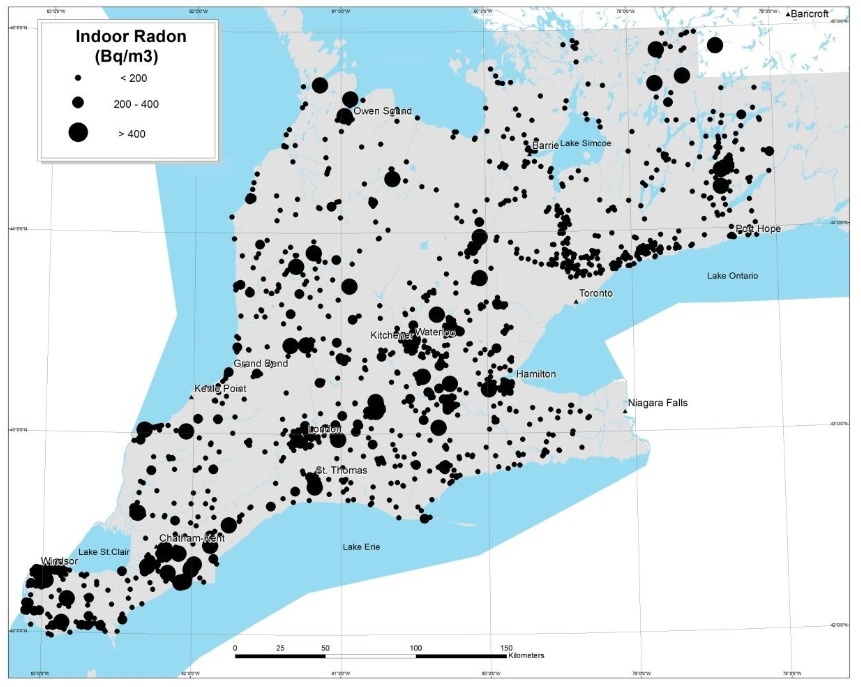
Thorium and uranium are commonplace but aren’t evenly distributed in the crust. Geology, soil type and glaciation all factor into the presence of radon for a particular location. Maps are available that show these areas. But the randomness of these factors combined together make it impossible to say which houses in a neighbourhood will be affected.
Testing is the only sure-fire way to know if you’re at risk if your house is in an area prone to radon. If higher than recommended levels are uncovered the installation of a ventilation system is a great idea and will completely alleviate the issue. The systems aren’t even that expensive, coming in at under $2,000. Here’s someone I know who does radon testing and mitigation, Tom Weber.
So yes, radon is a problem. Cancer is definitely something no one wants and radon elevates that risk. Even though only 7% of Canadian homes have dangerous levels, your home might be one of them. And radon is constantly transmuting, with a half life of only 3.8 days. Every time you breathe in some of the gas, a portion of the radon nuclei split, blasting your lungs with a tiny jolt of radiation. If you’re concerned, testing is the way to go. Your future self might thank you.